
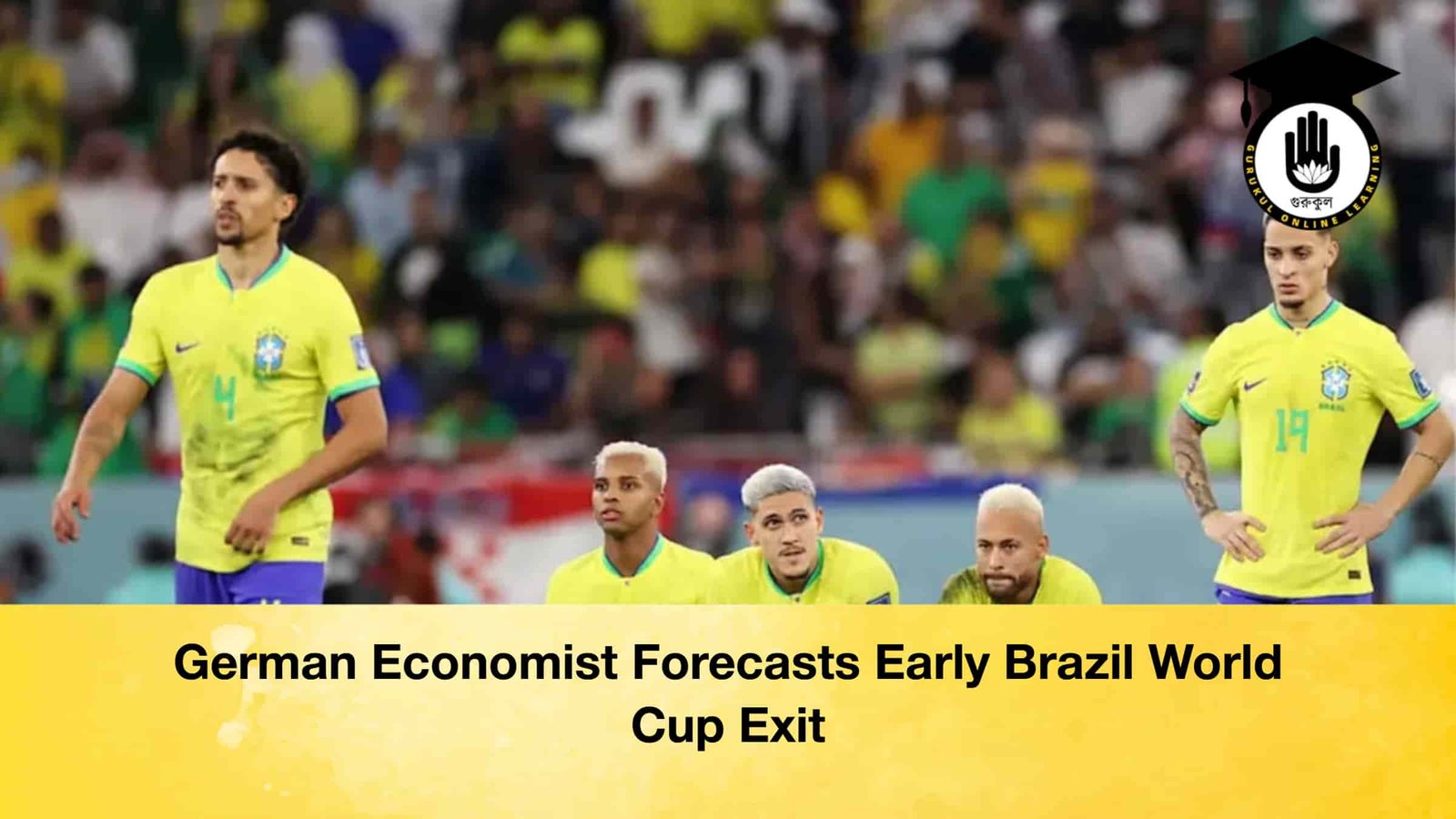

Five-time champions Brazil face a premature exit in the round of 32 at the upcoming FIFA World Cup, according to an econometric model designed by a prominent German economist. The analytical projection, which has successfully predicted the eventual winners of the last three iterations of the tournament, has tipped the Netherlands to secure their maiden global title in North America.
The mathematical simulation was developed by Joachim Klement, the head of investment strategy at British investment bank Panmure Liberum. Klement has established a notable reputation within sports analytics after accurately forecasting that Germany would lift the trophy in 2014, followed by France in 2018 and Argentina in 2022. For the 48-team tournament, his algorithmic model has selected a final between the Netherlands and Cristiano Ronaldo’s Portugal, with the Dutch projected to win.
Econometric Methodology and Predictive Indicators
Klement’s proprietary formula processes data using a dedicated algorithmic model rather than traditional sporting metrics alone. The system relies on five foundational socio-economic and athletic variables to evaluate the intrinsic strength and preparation of each competing nation.
The structural indicators driving the econometric model are detailed in the table below:
| Predictive Variable | Analytical Function & Justification |
| Per-Capita GDP | Measures economic capacity to fund training infrastructure, pitches, and academies. |
| Population Size | Determines the raw demographic pool from which elite sporting talent can be extracted. |
| Average Temperature | Evaluates local climate conditions; extreme variables negatively affect player development. |
| FIFA Ranking Points | Standardises the current competitive form and recent historical success of the national team. |
| Host-Country Advantage | Formulates the statistical weight added by local spectator support and home-ground familiarity. |
Projected Knockout Paths and Simulated Trajectories
According to Klement’s algorithmic notes, Brazil’s pursuit of their sixth title will end abruptly at the commencement of the single-elimination phase. While the South American team is projected to progress through the group stage, the simulation indicates they will be eliminated in the newly introduced round of 32.
Conversely, the model outlines a highly demanding knockout path for the Netherlands before they reach the final at MetLife Stadium on 19 July. The simulated route requires the Dutch side to systematically overcome Morocco and Canada in the initial knockout rounds, defeat tournament favourites France in the quarter-finals, and bypass Spain in the semi-finals.
The Role of Statistical Probability and Luck
Despite the absolute nature of the algorithmic output, Klement maintains that football results cannot be fully isolated from random variables. He explicitly cautions supporters against viewing the prediction as an infallible certainty, emphasizing that field performance remains subject to unpredictable developments.
Klement clarified that his mathematical equations allocate between 45 per cent and 50 per cent of the match outcome purely to elements of chance and situational luck, particularly when two closely matched teams compete. He noted that the model accounts for sporting upsets, stating that his previous three consecutive successes do not imply the possession of a magical crystal ball, as statistical variations remain active on any given matchday.