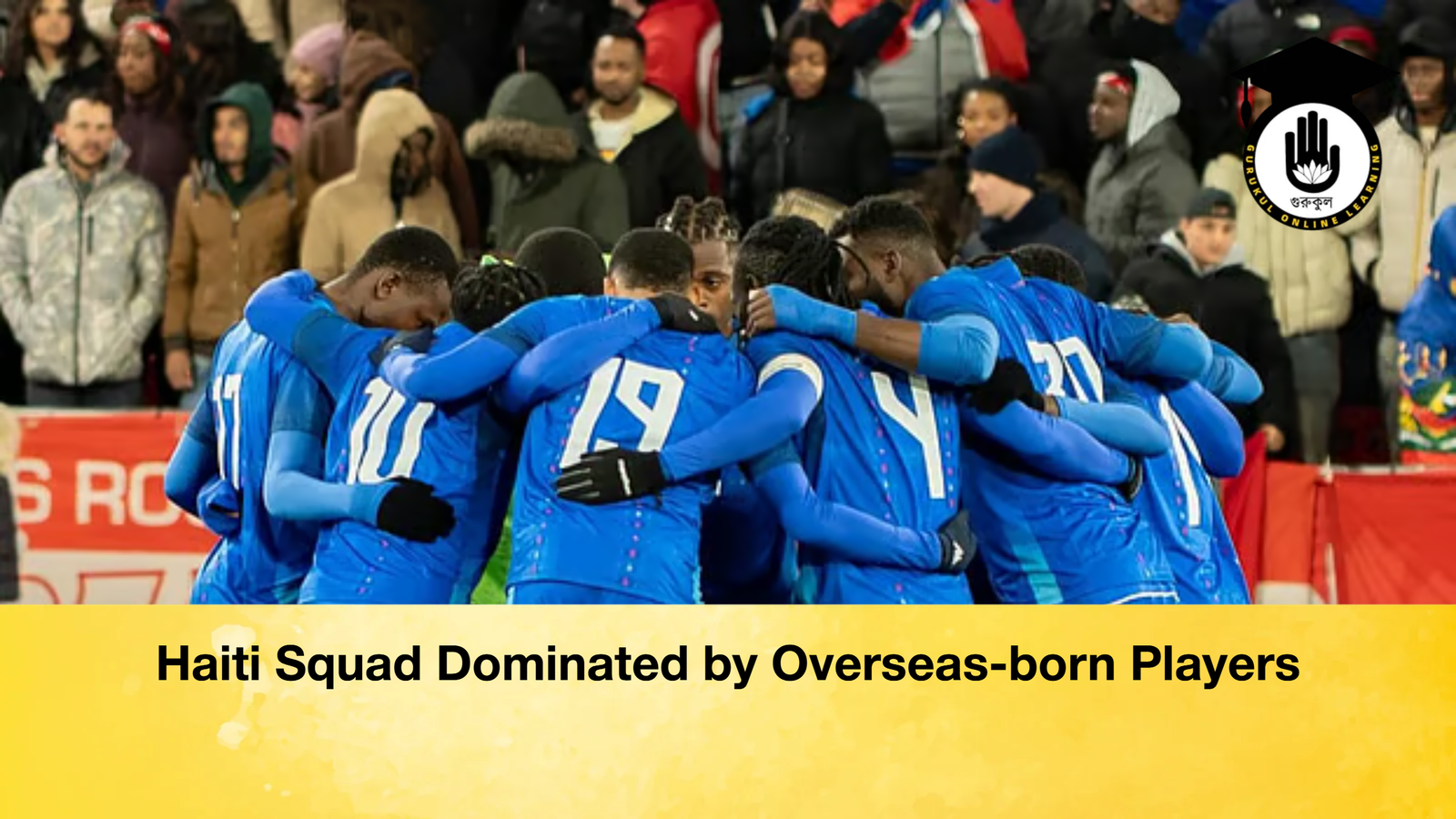

Haiti have announced their final 26-man squad for the World Cup, marking their return to the tournament for the first time since 1974. Analysis of the squad reveals that more than half of the players were born in France, alongside others born in the United States, Canada and Switzerland.
According to available squad details, only 10 of the 26 players were born in Haiti. The remaining 16 players were born abroad: 12 in France, two in the United States, one in Canada and one in Switzerland. Most of these players are eligible to represent Haiti through parental or grandparental lineage and have already made their international debuts for the national side.
A striking feature of the squad is that 25 of the 26 players are based outside Haiti and play their club football abroad. Only one player is registered with a domestic Haitian club. That player is Udnowsky Pierre, a 21-year-old midfielder representing Violette AC in Haiti’s domestic league.
The squad, selected by head coach Sébastien Migné, also includes several players competing in established European leagues. Among the most prominent names are Wilson Isidor, a forward at Sunderland, Jean-Ricner Bellegarde, a midfielder with Wolverhampton Wanderers, and Kito Thermoncy, who plays for Young Boys in Switzerland.
Haiti have been placed in Group C of the tournament, where they will face Brazil, Morocco and Scotland. Their opening fixture is scheduled for 13 June against Scotland.
Haiti World Cup Squad (26 Players)
| Position | Players |
|---|---|
| Goalkeepers | Johnny Placide, Alexandre Pierre, Josué Duverger |
| Defenders | Carlens Arcus, Wilguens Paugain, Duke Lacroix, Martin Expérience, Jean-Kévin Duverne, Ricardo Adé, Hannes Delcroix, Kito Thermoncy |
| Midfielders | Leverton Pierre, Carl-Fred Sainte, Danley Jean-Jacques, Jean-Ricner Bellegarde, Udnowsky Pierre, Dominique Simon |
| Forwards | Louisy Didier, Ruben Providence, Josué Casimir, Derrick Etienne, Wilson Isidor, Duckens Nazon, Frantzdy Pierrot, Yassin Fortune, Lenny Joseph |
The composition of the squad reflects a strong reliance on diaspora-born footballers developed across European and North American systems. This distribution also highlights the international spread of Haitian-eligible players, with a significant proportion having been born and trained outside the country while maintaining eligibility through family heritage.
With nearly the entire squad based in foreign leagues and extensive experience in competitive European football, Haiti enter the tournament with a group largely assembled from international club systems, while maintaining a minimal domestic representation.