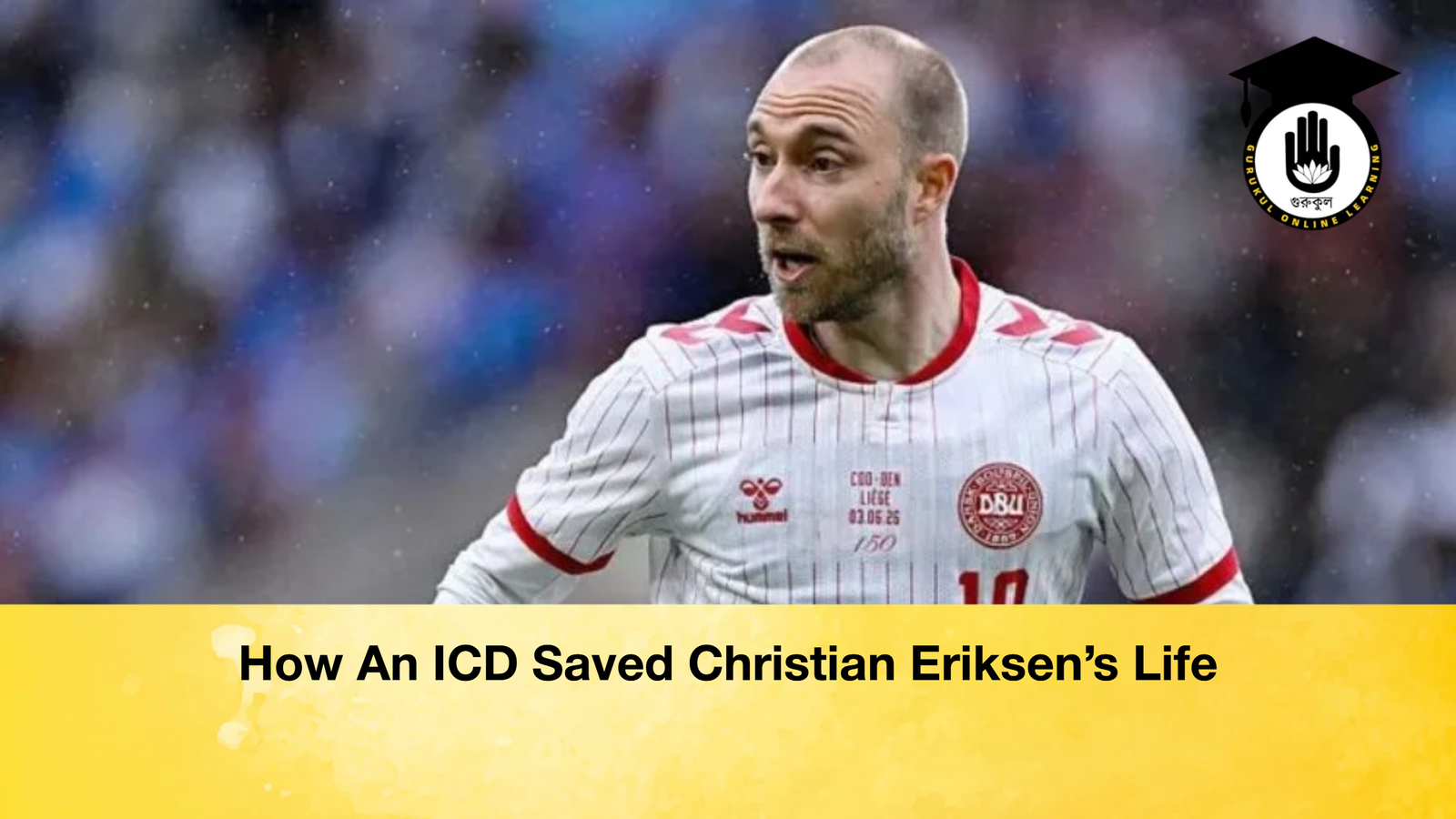
Danish football star Christian Eriksen has avoided a serious medical emergency after a specialised cardiac device implanted in his chest rapidly activated when he collapsed during an international match. The 34-year-old midfielder is currently recovering at home alongside his family.
Mechanism and Function of the ICD
An Implantable Cardioverter-Defibrillator (ICD) is a small, life-saving medical device designed to permanently monitor cardiac rhythms. If the device detects a dangerous disruption or irregularity in the heartbeat, it immediately intervenes to restore a normal rhythm. Medical experts emphasise that an ICD is not a permanent cure for underlying cardiac diseases, but rather a protective and preventative medical countermeasure.
During Eriksen’s recent match, the device identified an abnormally rapid and irregular heartbeat. It automatically delivered a controlled electrical shock, successfully restoring his heart to its normal rhythm. Discussing the mechanism, Professor Anil Malhotra, a sports cardiologist at Manchester Metropolitan University, stated: “It is very much like turning a computer off and restarting it again. An ICD is an extremely effective device.”
Eriksen shared an update regarding the incident on social media, writing: “My ICD protected me at the moment of need, exactly the way it was designed to function.”
The 2021 Copenhagen Collapse and Medical History
Eriksen’s cardiac history includes a severe episode five years prior, in 2021, when his heart stopped during a UEFA European Championship match. He lost consciousness on the pitch after suffering a sudden cardiac arrest. Immediate cardiopulmonary resuscitation (CPR) and the deployment of a portable automated external defibrillator (AED) successfully restarted his heart. Medical professionals concluded that this immediate pitchside intervention saved his life. Following that event, Eriksen underwent surgery to have the ICD permanently implanted. During his most recent match, the device autonomously activated to manage the recurring arrhythmia.
Etiology of Sudden Cardiac Arrest in Athletes
Medical professionals state that sudden cardiac conditions in competitive athletes can stem from several underlying factors, including:
Electrical signal faults within the heart
Myocarditis (inflammation of the heart muscle)
Structural cardiac abnormalities or cardiomyopathies
Genetic or hereditary predispositions
Infections or adverse reactions to specific medications
Although such cardiac events are statistically rare among young athletes, they are documented within professional football history. Prior to Eriksen’s experiences, midfielder Fabrice Muamba survived a sudden cardiac arrest on the pitch, whereas Cameroon international Marc-Vivien Foé tragically died after collapsing during a match.
The table below provides a historical and contextual overview of notable cardiac incidents involving professional footballers:
| Footballer | Nationality | Incident Context | Outcome / Current Status |
| Christian Eriksen | Danish | Collapsed at Euro 2021; suffered a subsequent arrhythmia episode. | Saved by CPR/AED in 2021; stabilized by an ICD; currently recovering. |
| Fabrice Muamba | British / Congolese | Suffered a sudden cardiac arrest during a competitive match in 2012. | Survived following extensive resuscitation; subsequently retired from football. |
| Marc-Vivien Foé | Cameroonian | Collapsed during an international tournament match in 2003. | Deceased due to underlying hypertrophic cardiomyopathy. |
Regulations Concerning Sports and ICDs
Recent medical research indicates that, under strict specialist supervision, certain athletes can safely return to competitive sports with an ICD. Contemporary medical guidelines stress that clinicians must discuss the specific risks and benefits with each player before reaching a collaborative decision.
However, regulatory frameworks vary significantly by jurisdiction. In Italy, sports medicine regulations strictly prohibit individuals with an implanted ICD from participating in both amateur and professional contact sports. Whether Eriksen will continue his professional football career remains unconfirmed. Medical specialists must first determine the exact cause behind the sudden alteration in his cardiac rhythm during the recent match to establish appropriate preventative strategies.
Statistical Overview of Cardiac Arrests
Data published by a prominent United Kingdom cardiac charity indicates that approximately 12 individuals under the age of 35 die from sudden cardiac arrest every week within the UK. A significant challenge for preventive medicine is that roughly 80 per cent of these cases occur without any prior symptoms or warning signs. Cardiologists emphasize that routine health screenings and the integration of modern medical technology are critical to reducing the mortality rates associated with sudden cardiac conditions. Eriksen’s recent stabilization serves as a verified case study demonstrating how timely technological intervention preserves human life.