
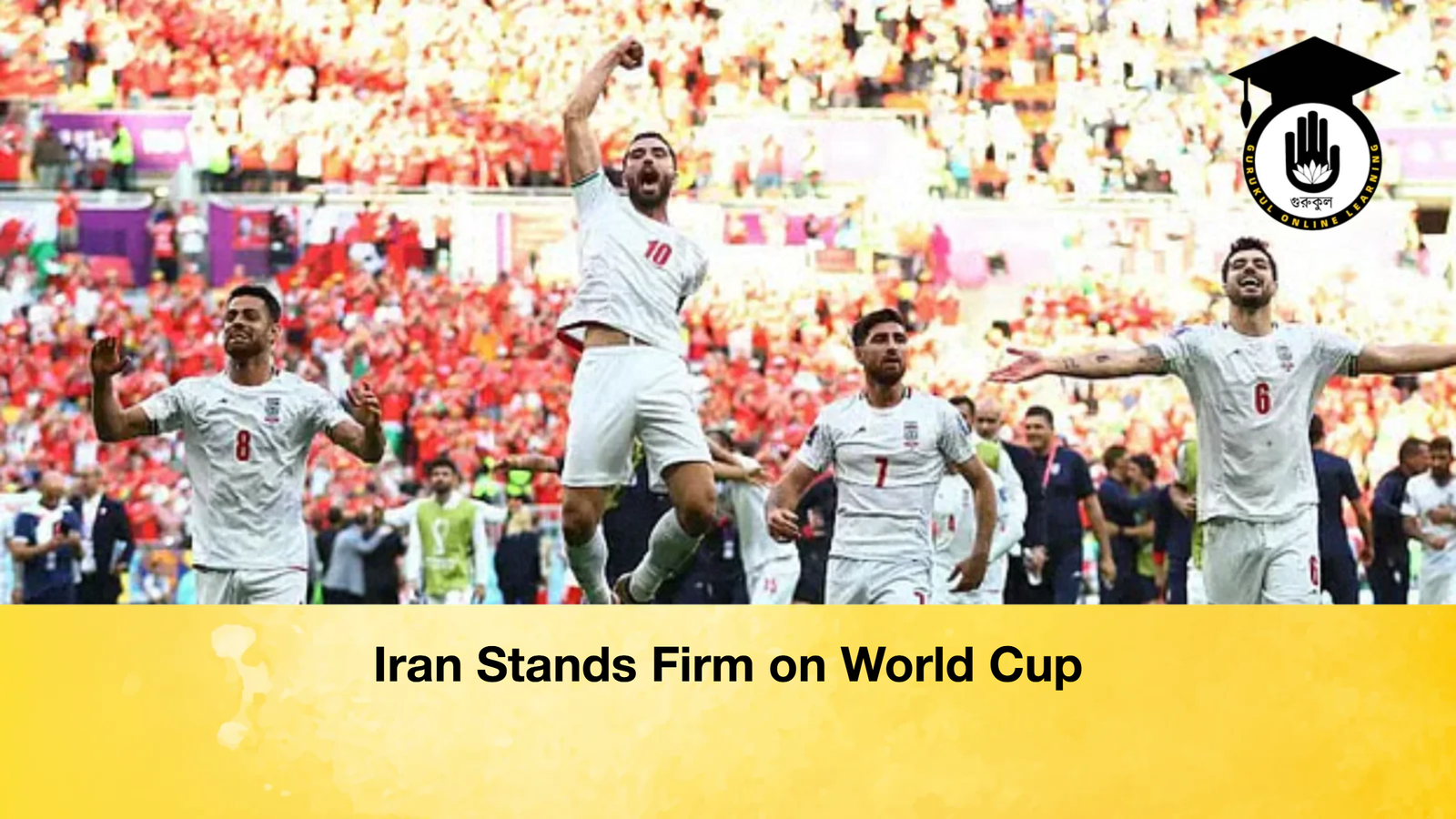

Iran’s national football team has made it unequivocally clear that it has no intention of withdrawing from the forthcoming FIFA World Cup, despite escalating geopolitical tensions. However, the team remains resolute in its refusal to travel to the United States, setting the stage for a complex standoff between sport and international politics.
Mehdi Taj, president of Iran’s football federation, reiterated the country’s position in emphatic terms, stating that while Iran is committed to competing in the World Cup, it will boycott the United States as a host nation. His remarks come amid heightened diplomatic friction between Tehran and Washington, which intensified in late February and have since cast doubt over logistical arrangements for the tournament.
The World Cup, scheduled to run from 11 June to 19 July, will be jointly hosted by the United States, Mexico, and Canada. Iran secured qualification early in the process, underlining its strong footballing credentials in Asia. Yet the political climate has complicated matters, particularly as all three of Iran’s scheduled group-stage matches are currently set to take place on American soil.
According to the official fixture list, Iran is due to play twice in Los Angeles and once in Seattle. Their group-stage opponents include New Zealand, Belgium, and Egypt—three teams with distinct playing styles that would ordinarily present a competitive but manageable challenge. However, the off-field situation now threatens to overshadow sporting considerations.
A summary of Iran’s scheduled group matches is provided below:
| Match | Opponent | Current Venue | Proposed Alternative |
|---|---|---|---|
| 1 | New Zealand | Los Angeles, USA | Mexico |
| 2 | Belgium | Los Angeles, USA | Mexico |
| 3 | Egypt | Seattle, USA | Mexico |
In response to these concerns, the Iranian federation has formally approached FIFA to request that its matches be relocated to Mexico. The governing body has acknowledged ongoing discussions but has so far indicated a preference to adhere to the original schedule announced on 6 December 2025.
Despite the uncertainty, Iran’s preparations for the tournament continue apace. The national squad is currently holding a training camp in Turkey, where it is also set to participate in a four-nation invitational tournament in Antalya. Iran will face Nigeria on 27 March, followed by a match against Costa Rica four days later. Originally planned to take place in Jordan, the competition was moved to Turkey due to instability in the Middle East.
Meanwhile, a separate controversy has emerged involving Iran’s women’s national team. During their participation in the Women’s Asian Cup in Australia, several players reportedly expressed concerns over their safety. The host nation offered asylum to members of the squad, with seven initially considering the proposal. Ultimately, only two players chose to remain in Australia, while the rest returned to Iran, where they were personally received by Mehdi Taj.
Adding to the tension, former US President Donald Trump made remarks suggesting that Iranian players might face security risks if they travelled to the United States for the World Cup, even as he simultaneously encouraged Australia to offer them refuge. Although he later clarified that no threat would emanate from US authorities, his comments have been seized upon by Iranian officials as justification for seeking a change of venue.
Mexico’s President, Claudia Sheinbaum, has since indicated her country’s readiness to host Iran’s matches if required, offering a potential समाधान that could ease tensions. Nevertheless, the final decision rests with FIFA, which must balance logistical feasibility, political sensitivities, and its overarching responsibility to ensure the safety and integrity of the tournament.
Bu Bosh, president of FIFPRO Asia-Pacific, has underscored that player safety is paramount, stressing that FIFA bears an institutional obligation to uphold human rights and guarantee security for all participants and spectators alike.