

Bangladesh returned from the 2026 Asian Games in Aichi-Nagoya with just one bronze medal despite sending a sizeable contingent of athletes, coaches and officials to Japan. The country fielded 187 athletes across 22 disciplines, with the overall trip reportedly costing around Tk 200 million.
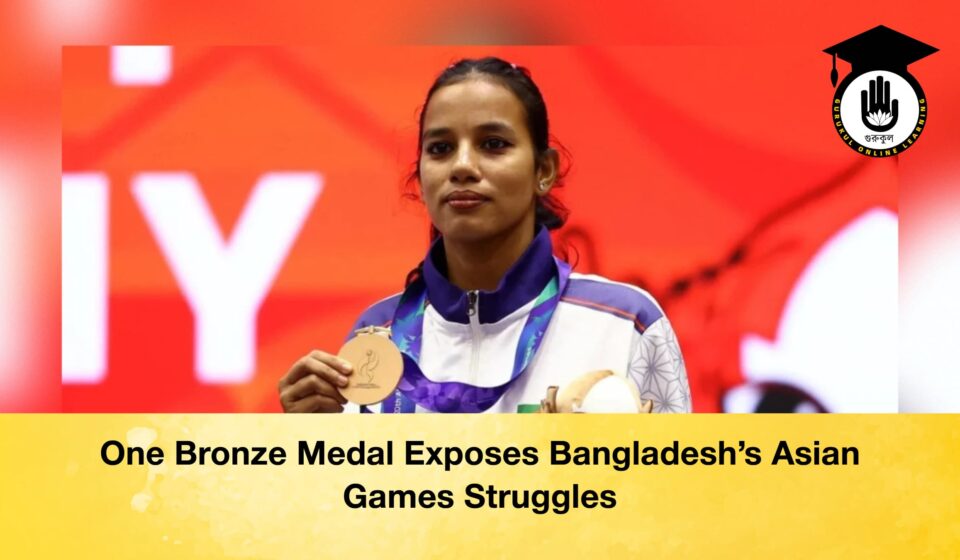
Expectations had been considerably higher, particularly in cricket, kabaddi, shooting and archery. Yet none of those disciplines produced a medal. Bangladesh’s sole podium finish came in wushu, where Jinnat Akter secured a bronze in the women’s 52kg category.
Jinnat guaranteed the medal by reaching the semi-finals, although her route to the last four was unusual. She received a bye in the opening round before advancing through the quarter-finals via a walkover. Her campaign ended in the semi-final, but the bronze nevertheless carried historical significance. It was Bangladesh’s first individual medal at the Asian Games since the 1986 Seoul edition.
The overall medal tally, however, underlined the growing gap between Bangladesh and several neighbouring countries. India collected 85 medals at the 2026 Games, while Pakistan won 10. Sri Lanka and Nepal also secured multiple medals. Bangladesh, by contrast, finished with only one.
Cricket had been regarded as the country’s strongest medal prospect. At the previous Asian Games in Hangzhou, both the men’s and women’s cricket teams won bronze medals. That success raised hopes of another podium finish in Japan, but neither side managed to repeat the achievement this time.
The men’s kabaddi team also appeared capable of challenging for a medal before its campaign unravelled. Bangladesh defeated South Korea and Chinese Taipei in its opening two matches, strengthening its position in the competition. The victory over Chinese Taipei prompted enthusiastic celebrations, but the team subsequently suffered defeat against hosts Japan and was eliminated from medal contention.
Kabaddi coach Abdul Jalil acknowledged shortcomings in the team’s defensive performance. He said the side needed more time to improve in that area and admitted that the celebrations after the Chinese Taipei victory had been premature. According to him, previous defeats against the same opponent may have contributed to the players’ emotional reaction after securing the win.
Archery was another discipline that carried significant expectations. Bangladesh had reasons to be optimistic after the compound men’s team won gold at the Asian Championships only a few months earlier. However, that success was not replicated on the Asian Games stage. Bangladeshi archers failed to come close to a medal in either individual or team events.
Archery coach Martin Frederick pointed to the limited size of the country’s talent pool as one of the major challenges. He said Bangladesh was working with around 400 archers, compared with more than 10,000 in India. In his view, expanding participation and beginning preparations well ahead of the next Asian Games would be essential if Bangladesh is to narrow the gap with stronger archery nations.
Shooting, another discipline from which Bangladesh had hoped for a strong showing, also failed to deliver. None of the country’s shooters managed to reach the finals, leaving another medal opportunity unfulfilled.
The hockey teams produced mixed results but did not challenge for the podium. The men’s side defeated Thailand 3-0 in its final classification match to finish seventh, although a fifth- or sixth-place finish had been within reach. The women’s team, competing at the Asian Games for the first time, finished ninth.
Taken together, the results represent a decline from the two bronze medals Bangladesh won at the 2022 Hangzhou Games. The outcome also raises broader questions about how the country approaches major multi-sport competitions.
A medal tally alone cannot capture every aspect of an international sporting campaign. Yet when a large contingent travels abroad after substantial expenditure and returns with a single medal, the quality of preparation, competitive exposure, athlete development and long-term planning inevitably come under scrutiny.
The Asian Games demand more than participation. Success at this level requires sustained investment in athletes, regular international competition, specialised coaching and careful preparation targeted at disciplines where genuine medal prospects exist. Several countries in the region are already pursuing long-term strategies to strengthen their sporting systems and broaden their competitive base.
For Bangladesh, the latest Games should therefore serve as an opportunity for a serious review rather than simply another entry in the participation record. The country needs to identify where preparation fell short, which disciplines require greater international exposure and how promising athletes can be supported over several years.
Jinnat Akter’s bronze provided a rare bright moment in an otherwise disappointing campaign. The larger challenge now is to turn that solitary success into a foundation for a stronger and more competitive sporting programme at future Asian Games.