
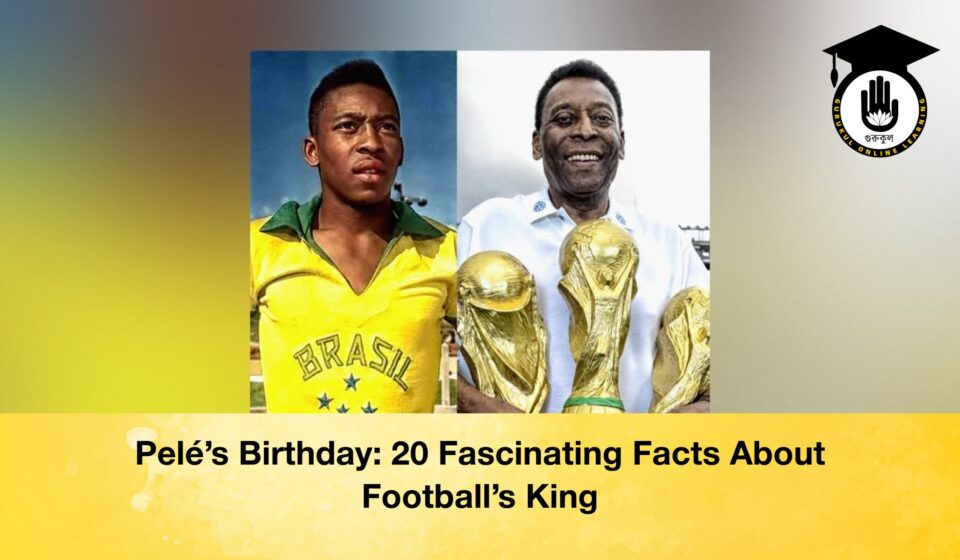

Pelé rose from humble beginnings in Brazil to become a global sporting icon. He won three World Cup titles, set remarkable scoring records and helped introduce football to audiences far beyond South America. His influence extended beyond the pitch, taking him into public service and making him a prominent figure in international sport.
Pelé died on 29 December 2022, aged 82. His birthday remains an opportunity to revisit the remarkable achievements, personal stories and lesser-known details that shaped his extraordinary life. Here are 20 fascinating facts about the legendary Brazilian.
1. Named after Thomas Edison
Pelé’s full name was Edson Arantes do Nascimento. His parents named him Edson in reference to the American inventor Thomas Edison. He grew up in a modest family in Brazil, where football became an important part of his childhood. His father, Dondinho, was also a footballer and helped nurture his early interest in the game.
2. The mystery behind his nickname
Pelé was reportedly known as ‘Dico’ within his family. One widely repeated account traces his famous nickname to his childhood difficulty pronouncing the name Bilé, a goalkeeper associated with a local team. Schoolmates subsequently began calling him Pelé. Although the precise origin has been debated, the nickname eventually became recognised across the world.
3. He disliked the name Pelé as a child
Despite becoming famous under the name, Pelé reportedly disliked the nickname during his childhood. He considered it an unpleasant-sounding name and preferred his given name, Edson. The nickname nevertheless stayed with him throughout his career, eventually becoming one of the most recognisable names in sporting history.
4. His childhood team was called ‘The Shoeless Ones’
As a boy, Pelé played football with friends in informal neighbourhood matches. One account of his early life refers to their team as ‘The Shoeless Ones’, reflecting the limited resources available to the young players. Playing without proper equipment did little to diminish his enthusiasm. Those early games helped him develop the control, creativity and instinct that would later distinguish him from other players.
5. His father reportedly scored five headed goals in one match
Pelé’s father, Dondinho, was a talented footballer in his own right. Accounts of the family’s sporting history credit him with scoring five headed goals in a single match. Pelé himself became renowned for his versatility and aerial ability, but a popular story holds that he never matched his father’s achievement in one game. The anecdote offers a glimpse into the footballing background from which the future superstar emerged.
6. A World Cup winner at just 17
Pelé announced himself to the world at the 1958 FIFA World Cup in Sweden. Aged just 17, he helped Brazil win the tournament and scored twice in the final against the hosts, which Brazil won 5–2. He remains the youngest player to score in a World Cup final. His performances made him an international sensation and marked the beginning of a remarkable career.
7. The only player to win three men’s World Cups
Pelé remains the only footballer to have won three men’s FIFA World Cup titles as a player. He was part of Brazil’s victorious squads in 1958, 1962 and 1970. An injury restricted his contribution during the 1962 tournament, but he played a major role in the other two triumphs. The achievement remains one of the most celebrated records in international football.
8. A career associated with 1,283 goals
Pelé is widely credited with scoring 1,283 goals during his career. This figure includes exhibition matches and other games that are not always counted as official competitive fixtures, so totals vary according to the records used. For Brazil’s senior national team, he scored 77 goals in 92 appearances. Neymar later surpassed that official international tally, but Pelé’s scoring record remains central to his legacy.
9. Eight goals in a single match
One of the most remarkable performances attributed to Pelé came on 21 November 1964, when Santos played Botafogo. Santos won 11–0, with Pelé reportedly scoring eight goals. The feat illustrates the extraordinary scoring power he displayed during his years with Santos, the club where he established himself as one of football’s greatest stars. Historical records may vary in their treatment of individual matches, but the performance remains widely cited.
10. Ninety-two hat-tricks
Pelé is commonly credited with scoring 92 hat-tricks during his career. The precise figure depends on which matches and competitions are included in the calculation. His scoring ability went far beyond finishing chances inside the penalty area. He could shoot powerfully from distance, beat defenders with close control, score with his head and create opportunities through intelligent movement. His versatility made him exceptionally difficult to contain.
11. His 1,000th goal and ‘Pelé Day’
On 19 November 1969, Pelé scored the 1,000th goal of his career from the penalty spot while playing for Santos against Vasco da Gama at Rio de Janeiro’s Maracanã Stadium. The milestone prompted huge celebrations, and supporters reportedly entered the pitch, interrupting the match for around 30 minutes. The occasion became one of the defining moments of his career. The date is commemorated as ‘Pelé Day’ in Santos.
12. His reported view of penalty goals
Pelé has often been associated with a remark describing a penalty as a cowardly way to score. The quotation is widely repeated, although its precise wording and context are not consistently documented. Despite the story, his reputation was built on a broad range of goals, from powerful strikes and headers to intricate dribbling and precise finishing. His ability to score in different situations helped make him one of the most complete attacking players of his era.
13. An unbeaten partnership with Garrincha
Pelé and fellow Brazilian great Garrincha formed one of the most celebrated attacking partnerships in international football. Their contrasting styles complemented each other, making Brazil a formidable opponent. A frequently cited statistic holds that Brazil never lost a match in which both players appeared together for the national team. Their partnership remains an important part of the story of Brazil’s rise to dominance in world football during the 1950s and 1960s.
14. His final international appearance
Pelé’s final appearance for Brazil came on 18 July 1971, when the team drew 2–2 with Yugoslavia. By that point, he had already become one of the defining figures in international football. His departure from the national team marked the end of a remarkable chapter, although he continued playing professionally for several more years.
15. He represented two clubs in his farewell match
Pelé’s professional farewell took place on 1 October 1977, in a match between New York Cosmos and Santos. He played the first half for Cosmos and the second half for Santos, bringing his professional career to an end. He had joined the American club in 1975, helping attract international attention to football in the United States at a time when the sport was seeking a wider audience.
16. Declared a national treasure by Brazil
In 1961, Pelé was reportedly declared an official national treasure by the Brazilian government. The designation is widely described as an effort to prevent wealthy European clubs from signing him away from Brazil. By then, his performances for Santos and the national team had made him one of the country’s most valuable sporting figures, both in footballing terms and as a symbol of national pride.
17. Recognised as an athlete of the century
Pelé received major recognition beyond football during the later years of his life. In 1999, the International Olympic Committee named him its Athlete of the Century in a widely reported honour. The recognition reflected his exceptional achievements and his influence on sport around the world. His fame extended well beyond Brazil, making him one of the most recognisable athletes of the 20th century.
18. Brazil’s Minister of Sport
Pelé entered public service after retiring from professional football. He served as Brazil’s Minister of Sport from 1995 to 1998, becoming one of the most prominent former athletes to hold a government position in the country. His appointment brought a globally recognised sporting figure into discussions about the administration and development of Brazilian sport.
19. The reported ceasefire in Nigeria
One of the most extraordinary stories associated with Pelé concerns a visit to Nigeria in 1967. According to a widely repeated account, opposing sides in the Nigerian Civil War observed a 48-hour ceasefire so people could watch him play. The story has become part of football folklore and illustrates the extraordinary appeal attributed to him. However, the precise circumstances and extent of the reported ceasefire are difficult to establish conclusively, so the claim is best treated as a popular historical account rather than an indisputably verified fact.
20. Offside rules existed throughout his career
A common misconception is that football had no offside rule during Pelé’s playing days. In fact, the rule had existed long before his career began. A significant change was introduced in 1925, when the number of opposing players required between an attacker and the goal line was reduced from three to two.
Offside interpretations have evolved since then. Modern officials consider whether a player in an offside position is actively interfering with play, obstructing an opponent or gaining an advantage. Some football observers have speculated that modern interpretations might have affected Pelé’s goal tally, but there is no reliable way to calculate how many additional goals he might have scored under today’s rules.
A legacy that transcends football
Pelé’s achievements extend far beyond his three World Cup victories. He became a global celebrity at a time when television was helping football reach audiences across continents. His performances helped establish Brazil as a dominant force in international football, while his move to New York Cosmos brought renewed attention to the game in the United States.
He died on 29 December 2022, aged 82, but his influence remains visible in the sport. His name continues to evoke extraordinary goals, historic victories and a style of play that inspired generations of footballers.
For millions of supporters, Pelé was more than a champion. He was a symbol of football’s ability to cross borders, connect cultures and create lasting memories. His place among the game’s greatest figures remains secure.