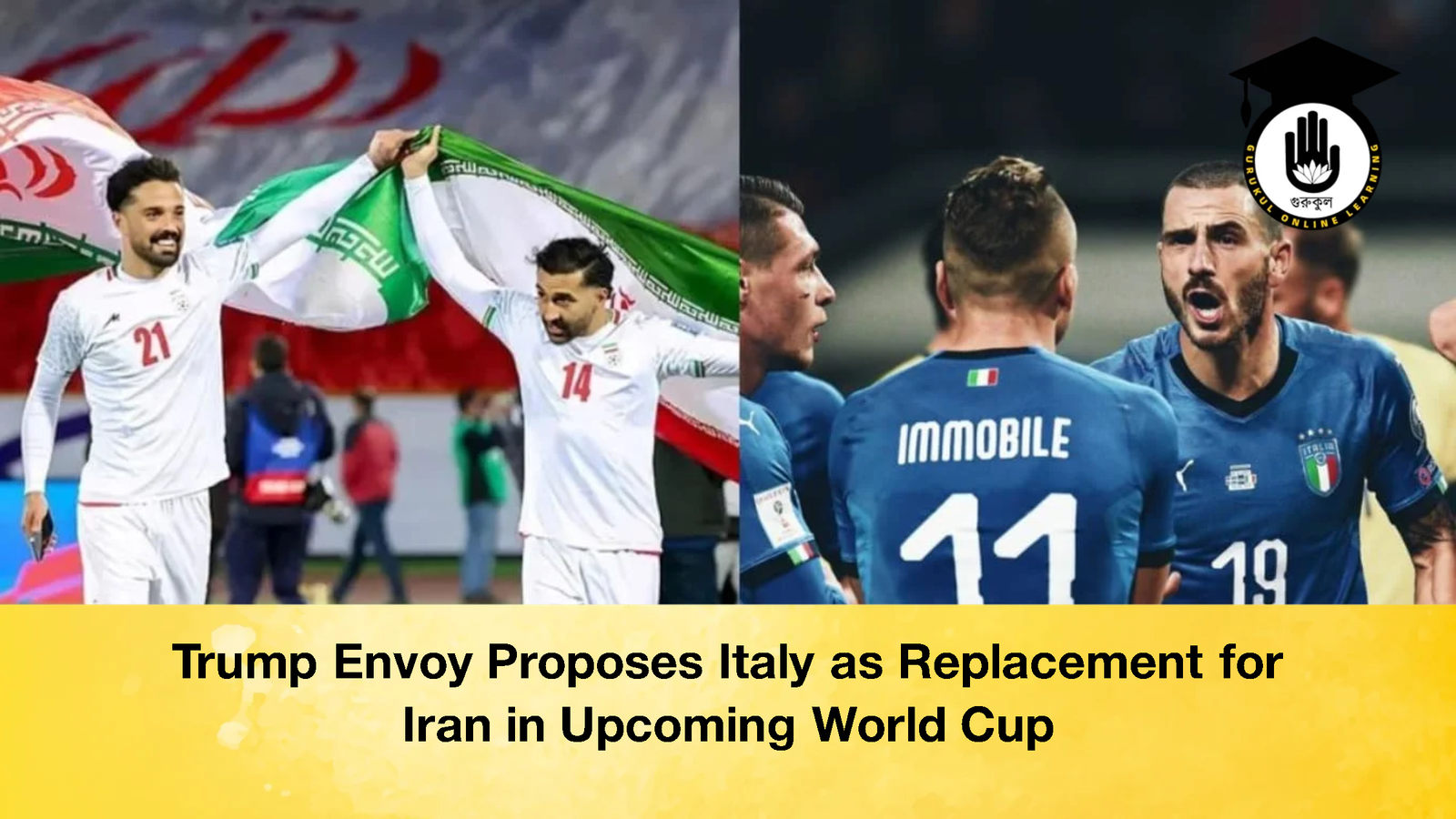

A senior official within the administration of United States President Donald Trump has sparked international debate by suggesting a fundamental alteration to the participant list of the upcoming FIFA World Cup. Paolo Zampolli, who serves as the President’s Special Envoy for Global Partnerships, has advocated for the inclusion of Italy in the tournament at the expense of Iran. The proposal was detailed in a recent interview with the Financial Times, a move that has resonated through both diplomatic and sporting circles.
Zampolli, an Italian-American diplomat, argued that the inclusion of the “Azzurri” would significantly enhance the prestige and commercial appeal of the competition. Highlighting Italy’s status as four-time world champions, he characterised the prospect of the Italian national team competing in a World Cup hosted on American soil as a “dream scenario” for organisers and the global footballing community.
Geopolitical Tensions and Diplomatic Objectives
The timing of Zampolli’s remarks appears deeply entwined with a volatile international landscape. Analysts suggest that the proposal may be a strategic attempt to offer a diplomatic olive branch to Rome. Relations between the Trump administration and the government of Italian Prime Minister Giorgia Meloni have been fraught following the President’s vocal criticisms of Pope Leo regarding the administration’s policy toward the Iranian crisis.
This suggestion emerges against a backdrop of escalating hostilities between Washington and Tehran. Following recent American military actions targeting Iranian interests, the Iranian Football Federation has submitted multiple formal petitions to FIFA, requesting that their scheduled fixtures be relocated from the United States to Mexico. Furthermore, the Iranian authorities have issued a formal ultimatum, threatening a total boycott of the tournament should their security and political concerns regarding United States venues remain unaddressed.
Principled Opposition from Italian Ministers
Despite the potential for a “wildcard” entry into the world’s premier footballing event, the Italian government and its athletic authorities have met the proposal with stern disapproval. The Italian position is rooted in the tradition of sporting merit, particularly as the national team failed to qualify for the tournament on the pitch in March 2026—a result that confirmed their third consecutive absence from the World Cup.
Leading figures in the Italian cabinet were quick to renounce the envoy’s suggestion:
Andrea Abodi, Italy’s Minister for Sport, dismissed the idea as “impossible and inappropriate”, stating firmly that qualification must be achieved through competitive play.
Giancarlo Giorgetti, the Minister of Economy and Finance, delivered an even more severe rebuke, describing the notion of an unearned entry as “shameful” and detrimental to the spirit of the game.
FIFA’s Adherence to Sporting Protocol
While political figures in Washington speculate on the tournament line-up, the governing body of international football, FIFA, has shown no sign of departing from its established regulations. Gianni Infantino, the President of FIFA, recently visited the Iranian national team’s training camp in Turkey. During this high-profile visit, he reaffirmed that all matches would proceed according to the predetermined schedule, effectively dismissing the possibility of a politically motivated team substitution.
Infantino’s visit served as a visible affirmation of institutional neutrality, signalling that the tournament remains a non-political sporting event. FIFA statutes explicitly prohibit government interference in the management of national footballing bodies or tournament structures. Under these rules, an envoy of a host nation holds no formal jurisdiction over which qualified sovereign nations are permitted to compete.
Regulatory Certainty Amidst Institutional Silence
As of late April 2026, neither the White House nor the Italian Football Federation (FIGC) has issued an official statement regarding Zampolli’s personal recommendation. In the absence of a catastrophic withdrawal by Iran or a radical shift in FIFA policy, the current regulatory framework remains the final word on participation.
The 2026 World Cup, co-hosted by the United States, Canada, and Mexico, continues its preparations to include all nations that secured their places through the continental qualifying rounds. Consequently, despite the diplomatic overtures from Paolo Zampolli, Italy remains excluded from the 2026 finals, and the “Azzurri” will have to look toward the 2030 qualification cycle for their return to the global stage.