LMGT3’s Factory Support Dilemma

As the FIA World Endurance Championship prepares for its 2026 season opener at Imola, one of the series’ most successful recent innovations—the LMGT3 class—finds itself facing a delicate philosophical question: how much factory support is too much?
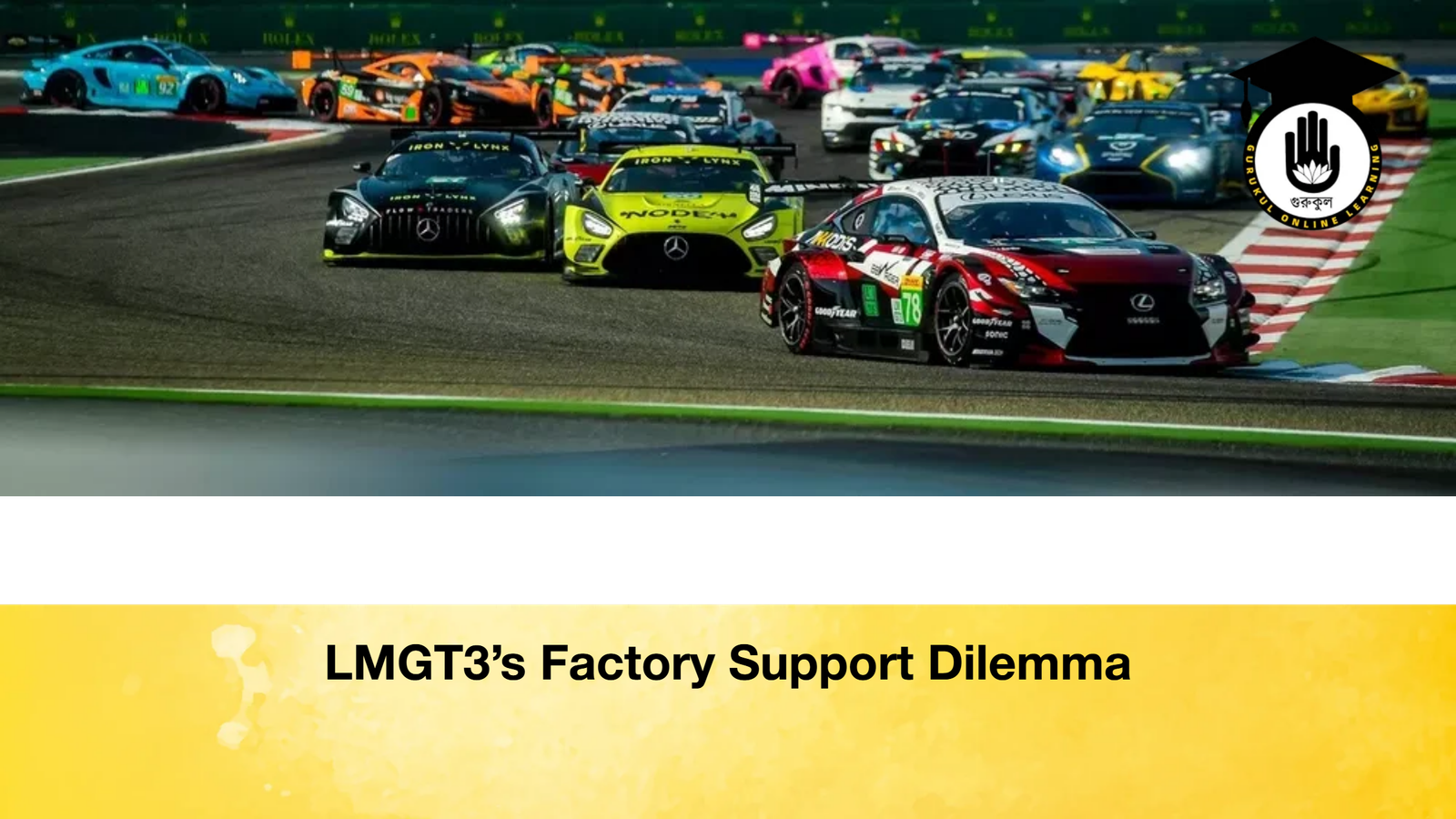
Introduced in 2024 as a replacement for GTE Am, LMGT3 was designed to be a cost-controlled, customer-focused category sitting beneath Hypercar. It has been an immediate sporting success, attracting a full grid of 18 entries for 2026—surpassing even Hypercar in numbers and bringing together a diverse mix of manufacturers and elite GT outfits.
Yet behind the façade of a “customer championship”, the reality is more nuanced. The scale of the WEC, combined with the prestige of events such as the 24 Hours of Le Mans, makes meaningful manufacturer involvement almost unavoidable.
LMGT3 at a glance
| Category factor | Status |
|---|---|
| Intended model | Customer racing only |
| Full-season entries (2026) | 18 cars |
| Driver format | Pro-am (1 pro per car) |
| Factory teams allowed | No |
| Typical manufacturer role | Technical & driver support |
A customer class with factory fingerprints
Manufacturers such as Toyota, Mercedes, Porsche and BMW are not permitted to enter full works teams, but they remain deeply embedded in operations through technical support, engineering staff, and carefully selected partner teams.
The model relies heavily on established collaborations. Ferrari works with AF Corse, BMW with WRT, and Porsche with Manthey—organisations that blur the line between customer and factory operations while remaining technically compliant.
Driver line-ups reinforce this structure. Each entry is limited to a single professional driver, but in practice platinum or gold-rated racers often determine race outcomes in final stints, particularly at Le Mans.
Engineering influence grows
One of the most detailed insights into LMGT3’s inner workings comes from Jérôme Policand of Akkodis ASP, which operates the Lexus programme in partnership with Toyota Gazoo Racing.
He describes a highly integrated support structure:
- Five factory engineers embedded per car (performance, engine, data and systems specialists)
- Continuous data exchange with a Cologne-based spare car programme
- Shared aerodynamic and suspension development between race and factory sites
“This is not just logistical support,” Policand explained. “It is deep technical involvement in how the car performs.”
However, he also cautions that LMGT3 budgets are climbing rapidly, driven largely by global logistics rather than the cars themselves.
The cost of global GT racing
While GT3 machinery is fundamentally cost-effective compared with Hypercar prototypes, the WEC’s global footprint significantly inflates budgets.
Teams now face:
- Intercontinental travel costs
- Large technical staffing requirements (up to 15 personnel per car in WEC spec)
- Complex logistics comparable to prototype racing
Policand warns that LMGT3 is approaching a financial threshold that risks undermining its original purpose if not carefully controlled.
Manufacturers: necessary, but controversial
From Mercedes’ perspective, LMGT3 would not function without manufacturer backing—but defining its limits is difficult.
Stefan Wendl of Mercedes-AMG Customer Racing argues that the category must remain flexible:
“Different levels of support exist naturally. The market will regulate itself over time.”
Others, including Manthey Racing—Porsche’s dominant LMGT3 partner—stress that success still depends on execution rather than hidden factory advantage.
Manthey managing director Nicolas Raeder insists:
“We are a customer team. Porsche does not run the operation—we do. The success comes from collaboration, not control.”
The central question
At its core, LMGT3 sits in a grey zone. Manufacturers are essential for competitiveness, yet overt factory dominance would undermine its identity as a customer series.
A compromise appears to be emerging:
- Manufacturers provide technical and driver support
- Teams remain operationally independent
- Budgets and staffing are capped by regulation and practicality
As Patrick Arkenau of Manthey puts it:
“LMGT3 must remain a true customer championship. Teams should prove themselves—not operate as disguised factory entries.”
A category at a crossroads
LMGT3 has succeeded in attracting grids, manufacturers, and fan interest. But its long-term stability will depend on maintaining a careful balance: enough factory support to keep competition fierce, but not so much that it becomes an arms race in disguise.
As the 2026 season begins, that balance has never been more important—or more difficult to maintain.