
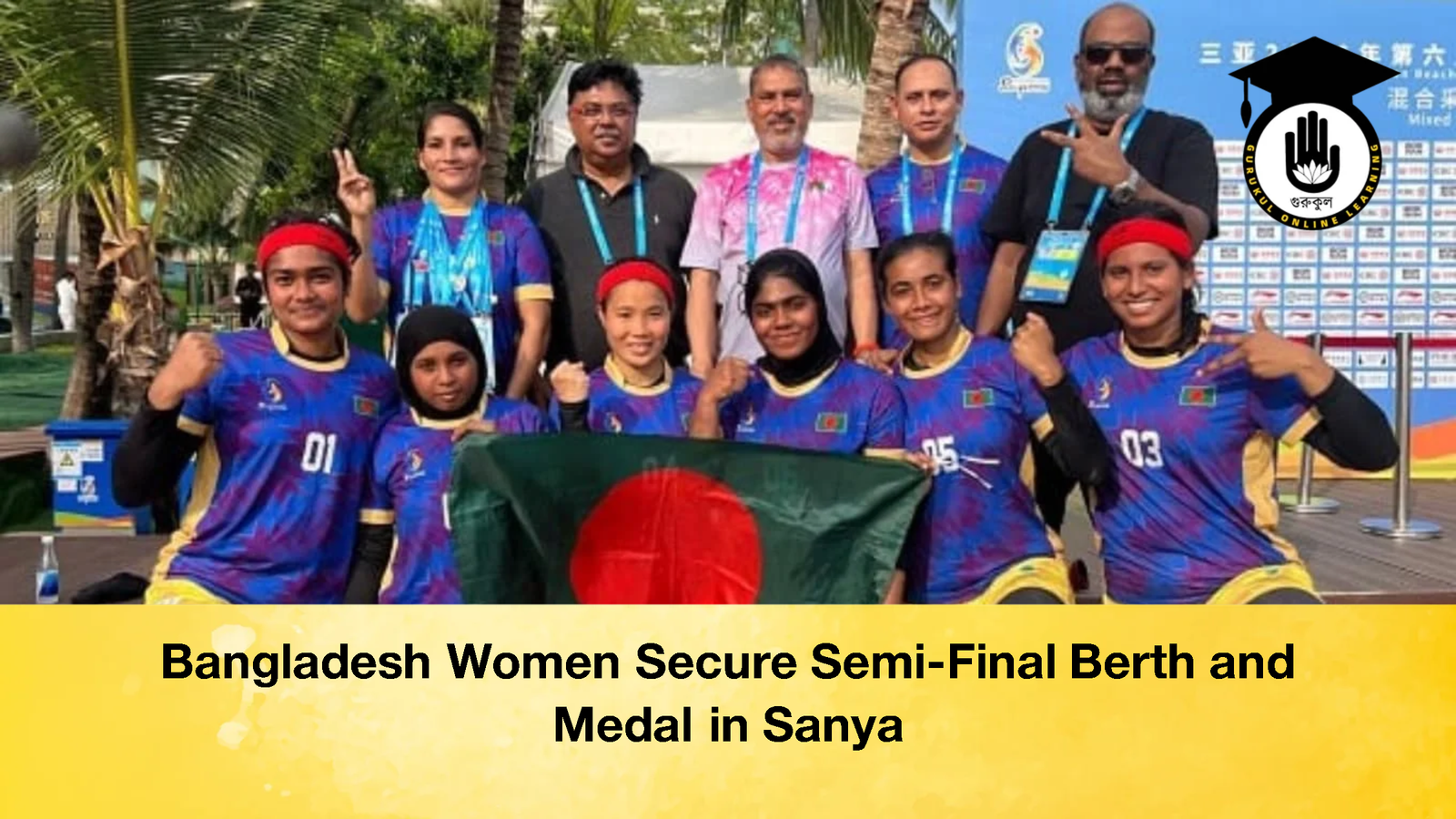

The Bangladesh national women’s beach kabaddi team has officially advanced to the semi-final stage of the Asian Beach Games in Sanya, China. By securing their second consecutive victory of the group stage on Saturday, 25 April 2026, the squad has confirmed at least a bronze medal for the nation. This achievement follows a dominant performance against Chinese Taipei, which came shortly after an impressive opening victory over Thailand.
Under the specific competitive framework of the Asian Beach Games, both losing semi-finalists in the kabaddi discipline are awarded bronze medals, as there is no third-place play-off. Consequently, by securing a position in the final four, the “Red and Green” representatives have formalised their presence on the overall medal tally, with the potential to upgrade to silver or gold in the coming days.
Tactical Review: Dominance Over Chinese Taipei
The encounter with Chinese Taipei was marked by a clinical display of tactical superiority and physical fitness from the Bangladeshi athletes. From the commencement of the fixture, the team exerted relentless pressure, combining swift offensive raids with a cohesive defensive line. This disciplined approach allowed Bangladesh to neutralise the opposition’s primary raiders early in the contest.
By the conclusion of the first half, Bangladesh had established a commanding lead of 25–11. Rather than adopting a defensive posture in the second period, the team increased their offensive intensity. They successfully dismantled the Chinese Taipei defensive formation on multiple occasions, securing several “lona” points—a bonus awarded when an entire opposing team is dismissed from the court. The match ended with a definitive score of 59–20, representing a 39-point margin of victory.
This result mirrors the prowess shown in their inaugural fixture against Thailand, where Bangladesh triumphed with a score of 51–34. These successive victories have placed the team at the top of the group table and have significantly boosted the squad’s confidence ahead of the knockout rounds.
Tournament Outlook and Group Supremacy
With a semi-final place now mathematically certain, the focus for the Bangladesh women’s team shifts to their final group-stage encounter. Scheduled for tomorrow, the team will face Nepal in a fixture that will determine the final standings of the group.
The outcome of this match is of high strategic importance:
Seeding: The group winner will likely face a lower-seeded opponent from the opposing group in the semi-finals.
Momentum: Maintaining an undefeated streak is seen as vital for psychological advantage entering the medal rounds.
Podium Path: Securing the top spot provides a theoretically smoother path to the gold-medal match.
The technical committee for the Bangladesh squad has indicated that while the primary objective of qualification has been met, they intend to field a strong side against Nepal to ensure they enter the semi-finals as group champions
Challenges for the Men’s National Contingent
In a stark divergence of fortunes, the Bangladesh men’s national beach kabaddi team has struggled to find form during their campaign in Sanya. On the same day that the women’s team secured their podium finish, the men’s squad suffered a second consecutive defeat, leaving their prospects of reaching the semi-finals in significant doubt.
Following an initial setback against Pakistan, the men’s team faced a formidable challenge against Iran, a nation widely regarded as a global powerhouse in both indoor and beach kabaddi. Despite a spirited second-half performance, the Bangladeshi men were unable to bridge the technical gap, eventually falling to a 47–31 defeat.
Following these successive losses, the men’s team is now dependent on a complex series of results in other group fixtures and a substantial victory in their final match to stand any chance of progression. The contrasting results between the two national teams highlight the rapid development of the women’s kabaddi programme, which has benefited from increased international exposure and rigorous training camps over the past eighteen months. All national attention now turns to the women’s team as they prepare for their final push towards a historic gold medal.