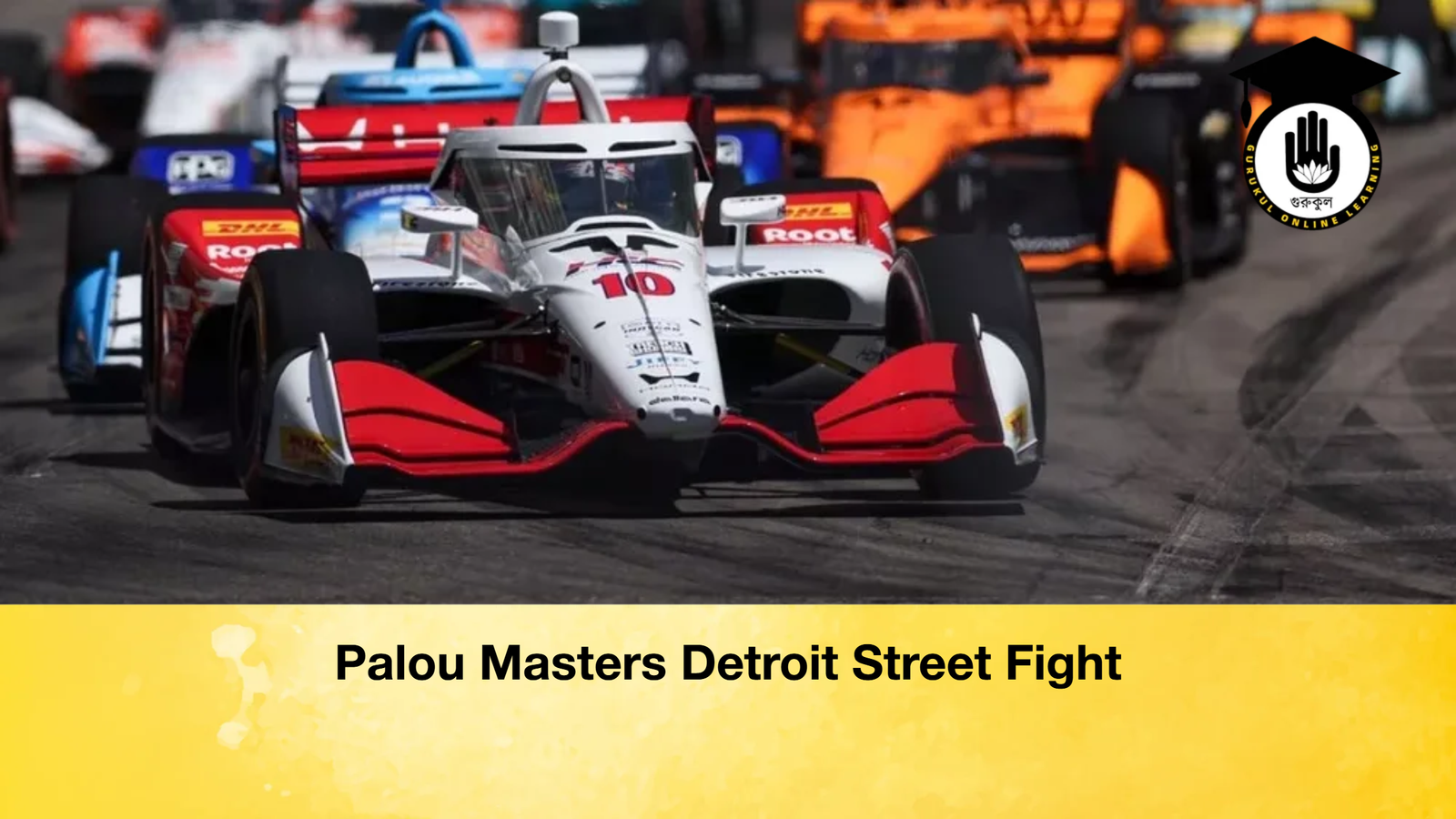

Alex Palou further strengthened his grip on the 2026 IndyCar championship with a composed and commanding victory in a chaotic Chevrolet Detroit Grand Prix, overcoming multiple cautions, strategic twists and a succession of late-race restarts to secure his fourth win of the season.
The reigning four-time IndyCar champion converted pole position into victory on the demanding downtown Detroit street circuit, crossing the line 3.0584 seconds ahead of Kyle Kirkwood after 100 laps of intense competition. The triumph marked the 23rd IndyCar victory of Palou’s career, drawing him level with Tommy Milton on the championship’s all-time wins list.
Completing the podium was Graham Rahal, whose recovery drive ensured a clean sweep of the top three positions for Honda-powered teams in what is traditionally considered Chevrolet’s home event.
Detroit Grand Prix Top 10
| Position | Driver | Team |
|---|---|---|
| 1 | Alex Palou | Chip Ganassi Racing |
| 2 | Kyle Kirkwood | Andretti Global |
| 3 | Graham Rahal | Rahal Letterman Lanigan Racing |
| 4 | Pato O’Ward | Arrow McLaren |
| 5 | Christian Lundgaard | Arrow McLaren |
| 6 | Felix Rosenqvist | Meyer Shank Racing |
| 7 | Louis Foster | Rahal Letterman Lanigan Racing |
| 8 | Marcus Ericsson | Andretti Global |
| 9 | Kyffin Simpson | Chip Ganassi Racing |
| 10 | Josef Newgarden | Team Penske |
Palou Controls Early Stages
Starting from pole position, Palou made a clean getaway and immediately began establishing control at the front of the field around Detroit’s 1.645-mile, nine-turn temporary street circuit.
Early pressure came from the Team Penske duo of Scott McLaughlin and Will Power, who quickly settled into the leading positions behind the Spaniard.
Palou built a two-second advantage before the opening caution appeared on Lap 10 when Christian Rasmussen crashed heavily into the Turn 2 barriers.
The restart produced one of the race’s defining moments. Power gradually closed on Palou and executed a decisive overtaking move into Turn 3 on Lap 18 to seize the lead. The veteran Australian appeared to have the pace to challenge for victory, while McLaughlin also remained firmly in contention.
As pit strategies began to diverge, the complexion of the race changed repeatedly. Palou briefly lost ground during a fierce battle with Power and McLaughlin, dropping to fourth place as Lundgaard moved ahead. However, a well-timed pit sequence and subsequent cautions allowed the Chip Ganassi Racing driver to regain track position.
Cautions Create Constant Drama
Detroit once again lived up to its reputation as one of IndyCar’s most unpredictable venues.
A second caution emerged on Lap 40 after Rahal was spun by teammate Kyffin Simpson in Turn 3. Although Rahal continued, he dropped deep into the order before beginning an impressive recovery.
Further interruptions followed when Santino Ferrucci collided with Rinus VeeKay, earning a drive-through penalty and triggering another full-course yellow.
Strategic fortunes fluctuated dramatically. Several drivers, including Alexander Rossi, briefly found themselves in podium contention through alternative fuel strategies. Rossi’s hopes were later dashed by a drive-through penalty for entering a closed pit lane during an earlier caution period.
The race then descended into further disorder during a restart with just under 30 laps remaining. David Malukas and Mick Schumacher made contact while disputing third position, allowing Kirkwood to move into a stronger position behind the leader.
Kirkwood Emerges as Main Challenger
As the closing stages approached, Kirkwood became Palou’s most significant threat.
The Andretti Global driver benefited from fresher tyres and repeatedly reduced the gap to the leader. Each time a caution period compressed the field, Kirkwood was handed another opportunity to attack.
However, Palou demonstrated precisely why he remains the benchmark of the series.
With 21 laps remaining, another caution neutralised the race after Ferrucci stopped on circuit. Shortly afterwards, Power’s challenge ended when damage sustained during a fierce battle with McLaughlin forced him to retire.
McLaughlin’s hopes also unravelled as the New Zealander was forced to pit with damage following contact between the two former Team Penske teammates.
Every restart became a test of nerve, but Palou executed each one flawlessly. Despite Kirkwood repeatedly closing within striking distance, the Spaniard consistently rebuilt a margin whenever green-flag racing resumed.
A final caution, caused after Rossi sent Romain Grosjean into a spin at Turn 3, set up a seven-lap sprint to the finish.
Champion Delivers Under Pressure
The final restart presented Kirkwood with one last chance to challenge for victory.
Instead, Palou immediately established control and gradually stretched his advantage. While Kirkwood pushed hard, he could not find a route past the championship leader.
Behind them, Rahal completed one of the strongest drives of the afternoon. Having been spun earlier in the race, the veteran climbed back through the order to secure third place while also resisting intense pressure from Pato O’Ward in the closing laps.
Arrow McLaren enjoyed a productive afternoon with O’Ward and Christian Lundgaard finishing fourth and fifth respectively.
Key Race Statistics
| Category | Detail |
|---|---|
| Race | Chevrolet Detroit Grand Prix |
| Circuit Length | 1.645 miles (2.647 km) |
| Turns | 9 |
| Winner | Alex Palou |
| Winning Margin | 3.0584 seconds |
| Pole Position | Alex Palou |
| Career IndyCar Wins | 23 |
| Season Wins (2026) | 4 |
| Manufacturer Sweep | Honda (1st–3rd) |
Palou’s victory was not his most dominant performance of the season, but it may prove one of his most significant. While rivals fell victim to incidents, penalties, damage and strategic misfortune, the Spaniard remained calm amid the chaos. In a race defined by uncertainty and constant interruptions, his ability to execute flawless restarts and maintain composure under pressure once again demonstrated why he remains the driver everyone else must beat in the fight for the 2026 IndyCar title.