
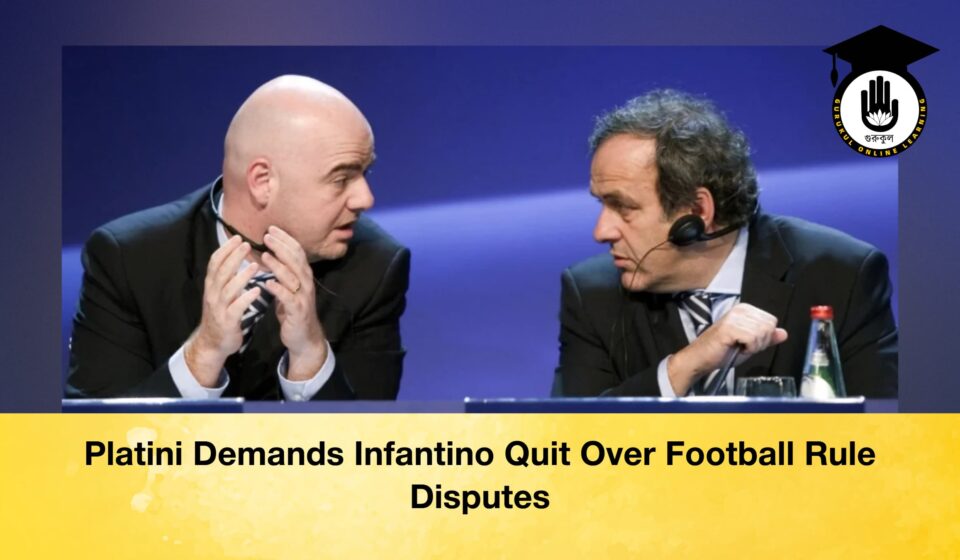

Former UEFA president Michel Platini has called for FIFA president Gianni Infantino to resign, accusing him of failing in his duty to protect and uphold the rules of football.
Platini’s remarks come amid renewed criticism of Infantino following the disclosure of a controversial proposal involving the sale of parts of the World Cup to private investors. Although the proposal was subsequently withdrawn, the issue has continued to generate debate over the direction of FIFA and the growing influence of commercial interests in international football.
Speaking to Canal+, Platini argued that the controversy should not be viewed simply as a question of finance. He said Infantino’s responsibilities extend to safeguarding the established rules and principles of the sport.
“Economic matters are one thing, but Infantino has failed because he is a guardian of football’s rules and has not respected them,” Platini said.
The French football great also criticised several aspects of match organisation, including hydration breaks during the World Cup and the 30-minute half-time interval used in the final. He questioned whether such changes were consistent with football’s established regulations, particularly when commercial considerations are involved.
“Advertising breaks are not a rule, and a 30-minute half-time in the final is not part of the rules either,” Platini said. He also criticised a red-card decision, describing it as an even more serious matter.
Platini was particularly direct when discussing Infantino’s position as FIFA president. He argued that someone entrusted with protecting football’s rules should be held accountable if those rules are not properly respected.
“He is the guardian of the rules. If he does not respect them, he must resign,” Platini said.
The former UEFA chief also accused Infantino of being attracted to money and power. He suggested that removing the FIFA president could prove difficult through the normal structures of sporting organisations and claimed that, if UEFA wanted Infantino to leave, legal proceedings might ultimately be necessary.
“I always knew that he loved money and power,” Platini said.
The criticism is significant given Platini’s own long involvement in football administration. He served as UEFA president and was once regarded as a leading candidate to succeed Sepp Blatter as FIFA president. His career at the top of European football, however, was disrupted by a financial controversy in 2015.
At the time, Platini faced allegations surrounding a payment of US$2 million from Blatter. The payment became part of a wider corruption investigation involving football’s governing institutions and affected Platini’s ambitions to lead FIFA. He denied wrongdoing and maintained that he was innocent, but stepped down from the UEFA presidency during the controversy.
Platini’s history within football administration adds a notable dimension to his latest criticism of Infantino. Both men have occupied influential positions in the international game, while questions over governance, financial interests and the balance between commercial priorities and sporting principles have repeatedly featured in debates surrounding football’s governing bodies.
Infantino has been at the helm of FIFA during a period in which the organisation has placed considerable emphasis on the commercial development of international football. The World Cup remains FIFA’s flagship competition and a major source of global revenue, making decisions about its organisation, commercial partnerships and format particularly sensitive.
The dispute over the reported investment proposal has therefore brought wider questions about the future direction of the World Cup into focus. Platini’s intervention adds a high-profile criticism from a former senior football administrator, but his demand for Infantino’s resignation does not itself determine the FIFA president’s future.
Any change at the top of FIFA would ultimately depend on the organisation’s governing structures and the support Infantino retains among its member associations. For now, Platini’s comments have intensified the public debate over how football’s global governing body should balance commercial interests with the rules and traditions of the sport.