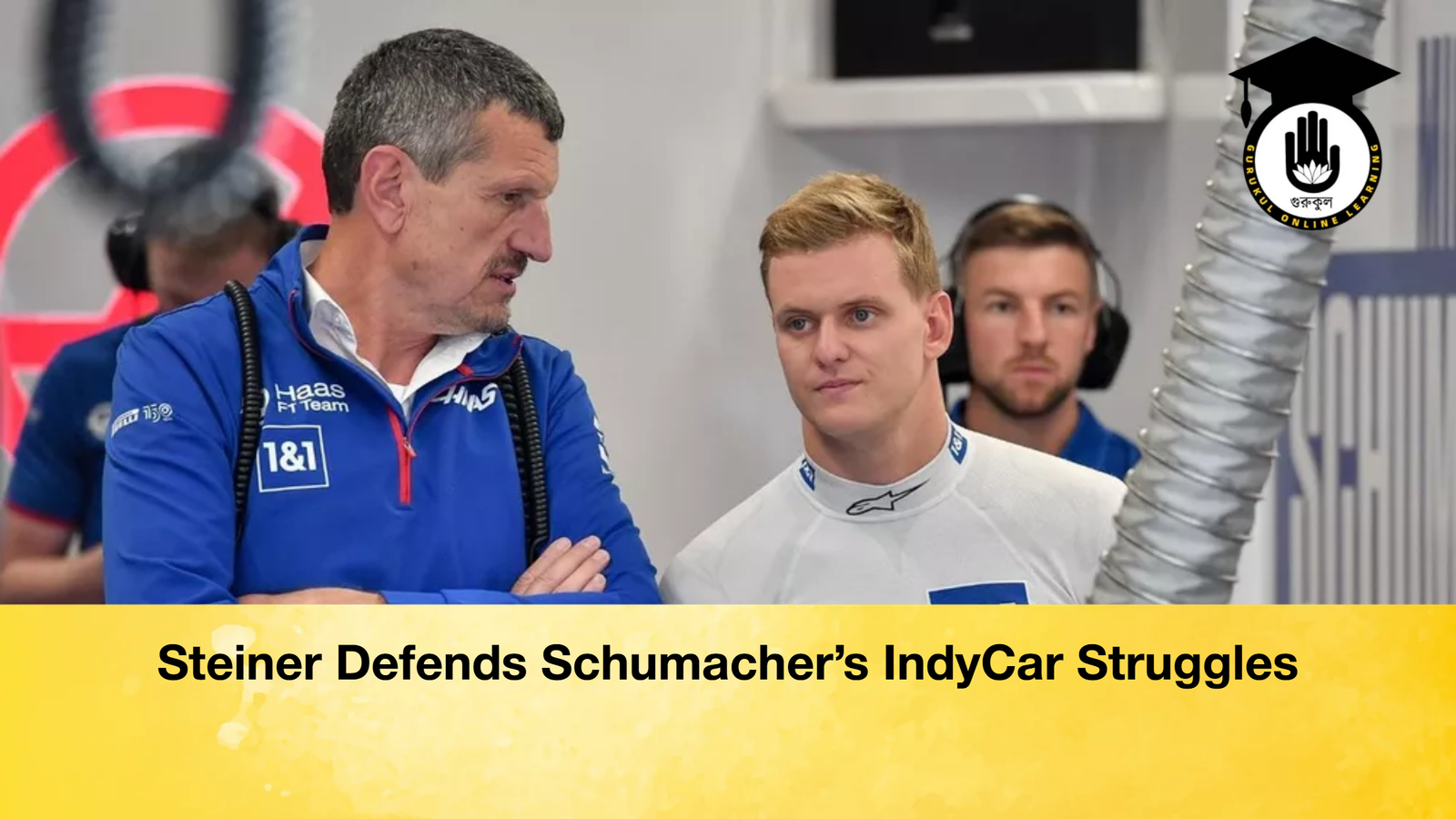

Former Haas Formula 1 team principal Guenther Steiner believes Mick Schumacher’s difficult debut IndyCar campaign has been unfairly judged, insisting many people underestimate the standard of competition in America’s premier open-wheel series.
Schumacher’s first full season with Rahal Letterman Lanigan Racing has proved a steep learning curve. Heading into the Road America weekend, the German rookie sits last among the full-time drivers in the championship standings, with a best finish of 16th.
However, Steiner argues that expecting Schumacher to arrive and immediately challenge for victories was always unrealistic. In his view, IndyCar’s depth of talent and the unique demands of the championship make it one of the most difficult series in world motorsport to master.
“Anyone who said Mick would go there and win is a dreamer,” Steiner told Motorsport.com.
“The bar is set high with the top drivers over there. They’ve been doing this for years. You can’t just walk in there.”
According to Steiner, the misconception stems from a tendency to view all top-level single-seater racing as interchangeable, when the reality is very different.
Different disciplines, different skills
Steiner believes comparisons between Formula 1 and IndyCar often overlook just how specialised modern motorsport has become.
Although both categories feature elite drivers and technologically advanced machinery, adapting from one to the other requires learning an entirely different set of skills.
To illustrate his point, Steiner compared the transition to changing athletic disciplines.
“They are both motorsport, but they’re different disciplines,” he explained.
“It’s like the 400-metre hurdles versus the 400-metre sprint.”
“They’re similar, but they’re not the same.”
Rather than expecting immediate success, Steiner believes Schumacher should be judged on how he develops over time as he gains experience on circuits, tyres, race procedures and strategy unique to IndyCar.
“We have to see how he develops.”
Pressure adding to the challenge
While adapting technically has proved demanding, Steiner also believes the mental side of Schumacher’s rookie campaign should not be overlooked.
The German arrived in North America carrying significant expectations, fuelled both by his Formula 1 background and his famous surname.
Steiner feels that external scrutiny—particularly from European audiences—has only increased the pressure Schumacher places upon himself.
“I think he’s putting too much pressure on himself right now because expectations are just so high,” Steiner said.
Before the season began, Schumacher had famously remarked that he did not wish to be regarded as a rookie despite being new to IndyCar, a statement that reflected his confidence but also raised expectations.
Instead, Steiner believes his current struggles fall well within what should have been anticipated for any newcomer.
IndyCar’s depth often underestimated
For Steiner, Schumacher’s situation also highlights a broader misconception about IndyCar itself.
He argues that many observers fail to appreciate just how competitive the championship has become, with experienced drivers capable of extracting the maximum from highly specialised machinery on a diverse calendar featuring street circuits, permanent road courses and high-speed ovals.
The series’ competitiveness means even accomplished Formula 1 drivers rarely dominate after making the switch.
To reinforce that argument, Steiner pointed to another of his former Haas drivers, Romain Grosjean.
Despite arriving in IndyCar with nearly a decade of Formula 1 experience, Grosjean is still searching for his first series victory after several seasons in North America.
“The bar is set high,” Steiner reiterated.
Motorsport has changed
Steiner dismissed comparisons with the early 1990s, when drivers could more readily move between categories and enjoy immediate success.
Perhaps the most famous example remains Nigel Mansell, who won the IndyCar championship in 1993 immediately after securing the Formula 1 World Championship.
According to Steiner, those circumstances no longer exist.
“That was a completely different era,” he said.
Modern motorsport, he argues, has become increasingly specialised, making rapid adaptation significantly harder than it once was.
Even legends of Formula 1 have discovered that first-hand.
Steiner cited Fernando Alonso’s attempts at the Indianapolis 500, including the Spaniard’s shock failure to qualify in 2019 despite being regarded as one of the finest drivers of his generation.
“Just look at Fernando Alonso,” Steiner said.
“It’s simply difficult.”
“The world was different 30 years ago.”
“These are disciplines you have to concentrate on.”
Adaptation works both ways
Steiner was equally keen to point out that the challenge is not exclusive to European drivers moving to America.
He believes leading IndyCar competitors would face similar difficulties if they attempted to establish themselves within Europe’s highly competitive single-seater ladder.
As an example, he highlighted Colton Herta’s move into Formula 2, where the accomplished IndyCar race winner has found life considerably tougher than many expected.
“The guys in Formula 2 are not bad,” Steiner said.
“They’re no pushovers.”
His argument is simple: success in one elite championship does not automatically translate into another, regardless of a driver’s reputation or previous achievements.
Schumacher’s season so far
| Category | Record |
|---|---|
| Team | Rahal Letterman Lanigan Racing |
| Championship position | Last among full-time drivers |
| Best finish | 16th |
| Season status | Rookie campaign |
With the second half of the season still to come, Schumacher has ample opportunity to demonstrate the progress Steiner believes is inevitable. Road America, with its flowing high-speed corners and permanent road-course layout, bears a closer resemblance to many European circuits than several other venues on the IndyCar calendar, potentially offering another valuable step in his development.
For Steiner, however, the broader message remains unchanged. Rather than judging Schumacher against unrealistic expectations, he believes fans should recognise the exceptional standard of competition throughout IndyCar. Success in the series is earned over time, not assumed on reputation, and that, in his view, is precisely what makes the championship one of the toughest in world motorsport.